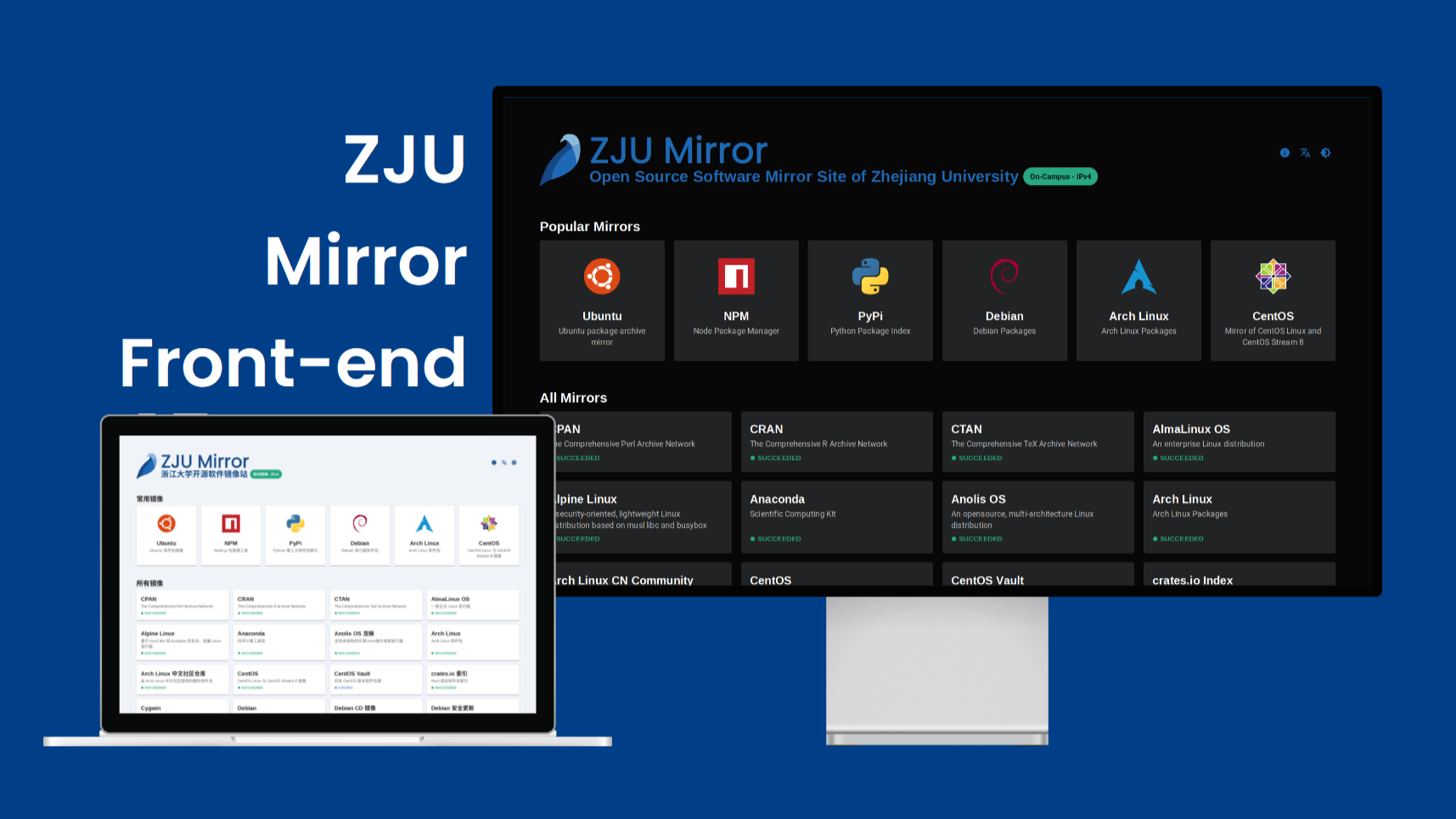
The ZJU Mirror portal is a statically generated Astro site with small React islands for live mirror status, search, and interactive MirrorZ guides. Back-end JSON format: mirrorz-json
The default appearance follows Material Design 2 guidelines for visual hierarchy, typography, spacing, controls, and interaction states. Use Material 2 as the reference for future UI changes while preserving the site's existing colors, flat surfaces, and responsive layouts. Components are implemented in the project's own CSS and React/Astro code; this does not require a Material component library. Optional game themes use their own visual language while retaining the shared interactions and page structure.
Development runs entirely in Docker with Node.js 22 and pnpm 10.15.1. Generated files and dependencies stay in Docker volumes and images.
export DEV_UID="$(id -u)" DEV_GID="$(id -g)"
docker compose build dev
docker compose run --rm dev git submodule update --init --recursive
docker compose run --rm dev pnpm install --frozen-lockfile
docker compose run --rm --service-ports dev
The development server listens on 0.0.0.0:4321. Type checking and optional
formatting can also be run locally with the same image:
docker compose run --rm dev pnpm check
docker compose run --rm dev pnpm format
For local UI review without live back-end endpoints, run:
docker compose run --rm --service-ports dev pnpm dev:reviewIt serves the populated dev/fixtures/mirrorz.json catalog and reports an
on-campus IPv4 connection so campus-only UI can be inspected.
The deployment marker is configured at build time. Production defaults to
DEPLOYMENT_ENV=production; set it to staging to add a fixed strip to every
page:
docker compose run --rm -e DEPLOYMENT_ENV=staging dev pnpm buildThe production Dockerfile accepts the same name as a build argument, so the
equivalent image build uses --build-arg DEPLOYMENT_ENV=staging.
Build the unprivileged production image, or start its production-style preview
on 0.0.0.0:8080:
docker build --tag mirror-front .
docker compose up --detach --build preview
Cluster-specific NGINX configuration can be mounted under
/etc/nginx/mirror-front/http.d and /etc/nginx/mirror-front/server.d for the
HTTP and server contexts, respectively. The portal supports both plain HTTP and
HTTPS behind the gateway. Keep directory redirects relative and omit HSTS and
CSP upgrade-insecure-requests so HTTP resources and same-site navigation are
not silently upgraded by the browser. MirrorZ links and generated guides may
still recommend HTTPS explicitly.
Run docker compose down when the preview is no longer needed; named development
caches are retained.
CI builds both images. The frontend build runs Astro/TypeScript checks, and
the exporter build runs its two focused tests. Pushes to main also
publish both GHCR images as latest and their seven-character commit
abbreviation. Registry cleanup retains the ten newest commit-tagged images
and removes unneeded untagged images.
A separate workflow lints and packages changes under charts/mirror-front/,
and publishes the OCI chart on pushes to main. It uses the version in
Chart.yaml; no Git release tags are needed. Chart-only changes skip image
builds.
The Helm chart manages the frontend, optional standalone statistics exporter (single-replica Deployment and Service), their configuration, Services, and an optional Gateway API HTTPRoute. Configuration is in values.yaml.
- ZJU announcements remain under
news/. - Generic interface glyphs primarily use Google Material Icons' baseline
family; brand marks use Iconify Logos or Simple Icons, while institutional
artwork remains in the local
resource/icons/collection. - The About, History, FAQ, Container Images, and Statistics pages live in
src/content/special-pages/, with one MDX file per page and locale. Their frontmatter supplies the page title and lead; the shared layout and presentation remain insrc/components/static/SpecialPage.astro. Keep matchingzh/anden/files when adding or renaming a page. - The Statistics page reads
/statistics-data/manifest.jsonand static PNGs generated hourly by the standalone statistics exporter and proxied by an NGINX snippet the chart injects when statistics are enabled. Its source, image build, configuration example, and deployment contract live understatistics-exporter/. Grafana panel selection is runtime configuration; changing it does not require rebuilding the frontend. - Shared mirror guides come from the pinned
vendor/mirrorz-docssubmodule, trackingmainatgit@github.com:ZJUSCT/mirrorz-docs.git(ZJUSCT fork of MirrorZ Docs). The parent repository's gitlink is the authoritative content pin;mirrorz-docs.lock.jsonrepeats the commit and license as build-time provenance because Docker builds do not receive Git metadata. Update the gitlink and manifest commit together when updating the guides. Every guide in the submodule is rendered unconditionally: route generation never consults the livemirrorz.jsoncatalog, so a mirror that is temporarily absent from it (for example mid-migration while its publish deployment is not Ready) keeps its guide page, and a guide without a hosted mirror still gets one. The mirror status island links to a guide only when one exists. - The browser consumes the same-origin
/mirrorz.jsonendpoint directly as MirrorZ Data Format v1.7. MirrorZ governs this public data contract. - Mirror file links are resolved from
site.urland each nativemirrors.urlvalue in that document. autoindex/index.htmlis a shared directory-listing shell. Hashed styles, fonts, images, and JavaScript remain under/_astro/, independently cacheable across mirrors and directories. Script hashes and integrity attributes limit executable code to the build output; mirrored files are not trusted scripts.
SiteLayout uses a centered 58rem reading area by default. The header,
article title, body, actions, and footer share the same content edges while
section backgrounds remain full-width. Home and directory listings use the
wide layout (96rem); Statistics uses statistics (88rem). These are maximum
content widths, with responsive gutters on smaller viewports. Guide and
directory watermarks belong to their title sections, not the viewport.
Keep long code blocks and tables horizontally scrollable within the content
area instead of widening the page.
The palette button offers Default, Terraria, and Stardew Valley. Visual style
(zju-mirror:siteTheme) is independent of light/dark/system mode
(zju-mirror:theme). Both preferences persist across navigation and synchronize
between tabs. New visitors receive the default Material 2 appearance. Game
skins deliberately use their own pixel typography, panels, and scenery;
interaction behavior and responsive content widths remain shared.
src/themes/registry.ts declares theme names, palettes, stylesheet URLs, and
optional scenery. Add a registry entry, palette in palettes.json, scoped
stylesheet, and assets to add a theme. shared.css contains the selector and
shared game presentation; artwork.ts supplies optional deterministic mirror
illustrations. Theme code changes presentation, not guide content, exported
Markdown, or mirror data. Timeline packing measures the active label font and
updates after theme changes and font loading.
Small palettes are emitted before first paint. A theme's stylesheet and artwork
load only on selection; unused game fonts are not requested by the default
appearance. The loader handles failed loads and rapid switching. Background
scenery is decorative and avoids the reading area; reduced-motion mode replaces
animated GIFs with still images. All fonts are self-hosted. Asset provenance and
font licenses are recorded in static/themes/ATTRIBUTION.md.
The controller is inlined and hashed by the existing directory-listing CSP build step. Keep it free of runtime script imports. Directory artwork is resolved from a build-time map so that the listing's strict script policy stays intact. Statistics images continue using their existing light/dark variants.
The catalog supports card, table, and timeline views and remembers the selected
view locally. The timeline shares catalog search and name preferences. It packs
events onto reusable tracks on a shared time axis, reserving space for labels.
Use the pan and locate buttons, or drag the chart in both axes to browse time.
The overview supports wheel zoom and dragging to pan. The canvas grows with
its tracks; vertical dragging scrolls the page instead of a nested viewport.
An active sync (Y) spans its start to the snapshot retrieval time; completed
syncs, previous successes (O), and scheduled syncs (X) are point markers,
not estimated durations. All available status markers are shown. Labels that do
not fit to the right of their marker face left, with space reserved in packing.
Creation times are omitted, and points
more than 48 hours before or after the snapshot are excluded. Long-running
active intervals are clipped at the left boundary. These are timestamps in the current MirrorZ snapshot,
not a retained history. Missing timestamps are never inferred, and elapsed
scheduled times are not treated as completed syncs.
Guide-specific controls follow their authored ztmpl positions: block inputs
appear immediately above their code example and keep independent selections.
global="true" controls remain at their position in the prose and apply across
the document. Only general mirror, protocol, and sudo settings stay at the top.
Every shared guide at /docs/<id>/ also has a static Markdown export at
/docs/<id>.md. Both language interfaces link to that same Chinese document;
the English interface does not imply an English translation. /llms.txt
indexes all exported guides with absolute URLs and identifies /mirrorz.json
as the source for the current mirror catalog and status. Guide publication is
independent of that runtime catalog.
“Copy page” exports the current release, endpoint, protocol, and command selections. “View as Markdown” uses the documented defaults. Both include source provenance, license, file paths, and append instructions. Clipboard failures fall back to selectable text, including on plain HTTP. Exported links use the canonical production origin even when reviewing the site locally.
The compiler retains Markdown with template placeholders alongside HTML. Both renderers resolve block-local and global inputs with the same semantics; hidden HTML comments are excluded. Do not generate exports from the browser DOM or maintain a separate copy of the guide content.
Run docker compose run --rm dev pnpm test:docs to check all vendored guides
and exercise template scoping, link conversion, and file instructions. The
production image build runs these tests before generating static pages.
-
Directory URLs serve the HTML shell regardless of
Accept. JSON is available only through/<mirror>/.mirror-index/<relative-directory>/, for example:curl https://mirrors.zju.edu.cn/debian/.mirror-index/ curl https://mirrors.zju.edu.cn/debian/.mirror-index/pool/main/
-
The reserved API namespace returns the full NGINX autoindex JSON array. Directory paths must end with
/; file requests through this API return 404. NGINX omits entries whose names start with a dot. The old Accept-based API is deliberately removed. -
The frontend sorts the full array but renders at most 200 entries per page. This bounds DOM work, not network transfer: large directories still download the complete array. There is no search feature or generated catalog.
-
Directory links within a mirror update browser history and fetch only JSON. Back/forward navigation works, superseded requests are canceled, and downloads, portal links, modifier clicks, and new tabs keep ordinary browser behavior. Requests allow up to 180 seconds for a first, uncached directory scan.
-
For a local production-style demo, mount a readable sample tree under
/usr/share/nginx/html/sample(without its ownindex.html), then open/sample/or request/sample/.mirror-index/. The bundled demo config uses the same API, without production's snapshot-scoped response cache. -
A standalone publish origin routes ordinary directories to the shell at
/autoindex/index.html, proxies the reserved API to cached NGINX autoindex, and leaves/_astro/routed to the portal. Deploy backend and frontend together: the API change is breaking. Old shells/assets are not kept across releases; a tab from a previous release may need reloading after an upgrade.
UI Designer: Rynco Maekawa